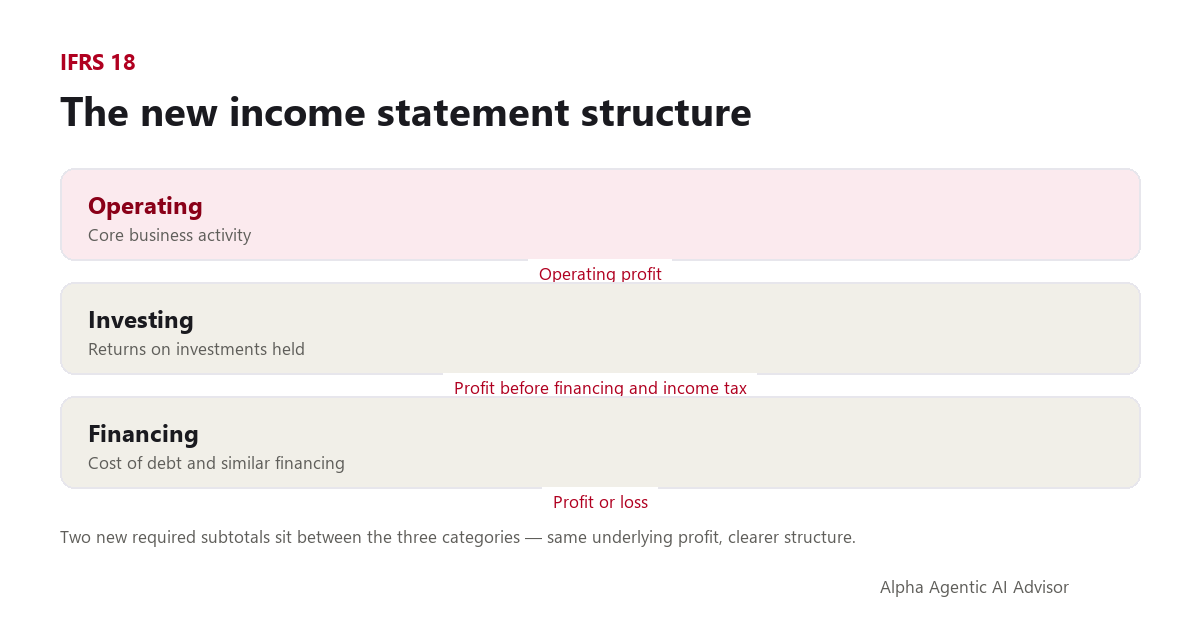
IFRS 18 Presentation and Disclosure in Financial Statements is a new standard issued by the IASB in April 2024. It replaces IAS 1 and applies to annual reporting periods beginning on or after 1 January 2027, with earlier application permitted. It does not change how much profit a company reports — it changes how the income statement is structured, so that two companies' results become easier to compare line by line.
The headline change: three categories, two new subtotals
Every income and expense line in the statement of profit or loss must now be classified into one of three categories:
- Operating — the entity's main revenue-generating activity, and the default category for anything that doesn't clearly belong in the other two
- Investing — returns from investments held largely independently of other resources, such as associates, joint ventures, and investment property
- Financing — the cost of raising debt and similar financing, including most interest expense
Income tax and discontinued operations continue to be presented separately, as under IAS 1. Two new required subtotals sit between the categories: operating profit, and profit before financing and income tax. The familiar bottom-line profit or loss is unchanged.
A new defined term: management-defined performance measures
Many companies already publish their own subtotals — "adjusted EBITDA," "underlying profit" — in press releases and investor presentations. IFRS 18 formally defines these as management-defined performance measures (MPMs) whenever they represent a measure of an entity's financial performance beyond an IFRS-specified subtotal, and requires them to be disclosed in a single note to the financial statements: the amount, why it's useful, how it's calculated, and a reconciliation to the most comparable IFRS-specified subtotal, including the tax effect and effect on non-controlling interests.
Clearer rules on grouping information
IFRS 18 also strengthens the principles for aggregation and disaggregation — grouping items that share characteristics together, and not burying dissimilar items inside a catch-all "other" line just because each is individually small. This affects how the notes are structured, not only the primary statements.
Where this typically goes wrong
- Treating IFRS 18 as a measurement change — it isn't. Recognition and measurement of income and expenses are unchanged; only presentation and disclosure are affected
- Assuming an existing "adjusted" metric can keep its current definition and disclosure unchanged once it meets the MPM definition
- Defaulting ambiguous items to "operating" without applying the actual classification criteria for investing and financing items
- Leaving the transition and comparative-period restatement until close to the 1 January 2027 effective date, rather than mapping the current income statement onto the new structure early